publications
Some publications related to my work.
2026
-
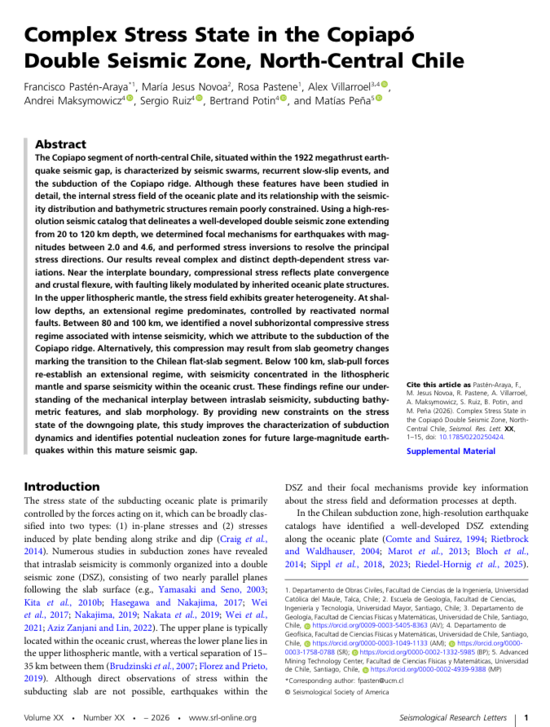 Complex Stress State in the Copiapó Double Seismic Zone, North-Central ChileFrancisco Pastén-Araya, María Jesus Novoa, Rosa Pastene, and 5 more authorsSeismological Research Letters, Jul 2026
The Copiapo segment of north-central Chile, situated within the 1922 megathrust earthquake seismic gap, is characterized by seismic swarms, recurrent slow-slip events, and the subduction of the Copiapo ridge. Although these features have been studied in detail, the internal stress field of the oceanic plate and its relationship with the seismicity distribution and bathymetric structures remain poorly constrained. Using a high-resolution seismic catalog that delineates a well-developed double seismic zone extending from 20 to 120 km depth, we determined focal mechanisms for earthquakes with magnitudes between 2.0 and 4.6, and performed stress inversions to resolve the principal stress directions. Our results reveal complex and distinct depth-dependent stress variations. Near the interplate boundary, compressional stress reflects plate convergence and crustal flexure, with faulting likely modulated by inherited oceanic plate structures. In the upper lithospheric mantle, the stress field exhibits greater heterogeneity. At shallow depths, an extensional regime predominates, controlled by reactivated normal faults. Between 80 and 100 km, we identified a novel subhorizontal compressive stress regime associated with intense seismicity, which we attribute to the subduction of the Copiapo ridge. Alternatively, this compression may result from slab geometry changes marking the transition to the Chilean flat-slab segment. Below 100 km, slab-pull forces re-establish an extensional regime, with seismicity concentrated in the lithospheric mantle and sparse seismicity within the oceanic crust. These findings refine our understanding of the mechanical interplay between intraslab seismicity, subducting bathymetric features, and slab morphology. By providing new constraints on the stress state of the downgoing plate, this study improves the characterization of subduction dynamics and identifies potential nucleation zones for future large-magnitude earthquakes within this mature seismic gap.
-
 Generación estocástica de terremotos tsunamigénicos y su impacto en la deriva de contenedores en el puerto de ValparaísoAlex Villarroel CarrascoMar 2026
This study aims to develop a framework to generate realistic stochastic slip scenarios by incorporating interseismic coupling as a priori information, along with physical constraints, including rupture boundaries defined by the segmentation of the Chilean subduction margin and the seismogenic zone. The proposed stochastic framework is applied to the Concepción, Valparaíso, and Iquique segments, generating tens of thousands of slip scenarios. Tsunami simulations based on the selected scenarios reproduced observed waveforms at multiple tide gauges, and the ensemble approach effectively quantifies uncertainty in tsunami hazard assessment, complementing deterministic methods and highlighting the influence of interseismic coupling on coseismic slip variability.